BULL TERRIER
Origin: Great Britain
Date of official standard publication: 05 July 2011
Function: Terrier
Working trial: Optional
Brief Historical Overview
The breed was first standardised during the 1850s by James Hinks, who selected the distinctive egg-shaped head. Bull Terriers were first exhibited in their modern form in Birmingham in 1862. The Bull Terrier Club was established in 1887.
One of the most notable points of the standard is the clear statement that there are no height or weight restrictions; instead, dogs should give the impression of maximum substance relative to their size, while maintaining quality, balance, and correct sex characteristics at all times.
A smaller version of the Bull Terrier existed as early as the 19th century but lost popularity before World War I and was removed from the Kennel Club register in 1918. In 1938, Colonel Richard Glyn and a group of enthusiasts revived interest by founding the Miniature Bull Terrier Club. The Miniature Bull Terrier follows the same standard as the Bull Terrier, with the exception of a height limit.
General Appearance
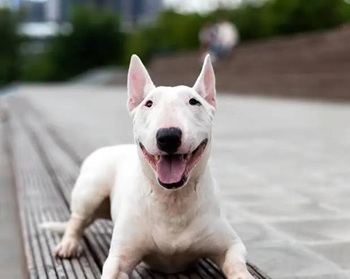
Strongly built, muscular, well balanced, and active, with an alert, determined, and intelligent expression. The most distinctive feature is the down-faced, egg-shaped head. Regardless of size, males should appear masculine and females feminine.
Behaviour / Temperament
Bold, lively, and playful in attitude. Even-tempered and responsive to training. Though sometimes stubborn, the breed is especially good with people.
Head
Long, powerful, and deep to the tip of the muzzle without coarseness. When viewed from the front, the head is egg-shaped and completely filled, free from indentations. In profile, it curves smoothly downward from the top of the skull to the nose.
Cranial Region – Skull: Almost flat from ear to ear.
Facial Region – Nose: Black, with the tip curving downward; nostrils well developed.
Lips: Tight and clean.
Jaws / Teeth: Lower jaw deep and strong. Teeth should be strong, clean, well sized, and regularly placed, forming a correct and complete scissor bite, with upper teeth closely overlapping the lower teeth and set square to the jaws.
Eyes
Narrow, triangular, and set obliquely. Eye colour should be black or as dark brown as possible, appearing almost black, with a sharp, piercing expression. The distance from the nose tip to the eyes should be clearly greater than from the eyes to the top of the skull. Blue or partially blue eyes are undesirable.
Ears
Small, thin, and placed close together. The dog should be able to hold them firmly erect, pointing straight upward.
Neck
Very muscular, long, and arched, narrowing from shoulders to head, and free from loose skin.
Body
Rounded with well-sprung ribs and great depth from withers to brisket, bringing the brisket closer to the ground than the belly.
Back: Short and strong, level behind the withers, with a slight arch over the loins.
Loin: Broad and well muscled.
Chest: Broad when viewed from the front.
Underline and Belly: Forms a smooth, elegant upward curve from brisket to belly.
Tail
Short, set low, and carried horizontally. Thick at the base and tapering to a fine point.
Limbs
Forequarters – General appearance: Legs should be strong and perfectly parallel, supporting the dog solidly. In mature dogs, the length of the forelegs should be approximately equal to the depth of the chest.
Shoulders: Strong and muscular without being heavy. Shoulder blades wide, flat, close to the chest wall, and sloping sharply backward, forming an almost right angle with the upper arm.
Elbows: Firm and straight.
Forearm: Forelegs should have strong, round, high-quality bone.
Pasterns: Upright.
Forefeet: Round and compact with well-arched toes.
Hindquarters – General appearance: Hind legs parallel when viewed from behind.
Thighs: Well muscled.
Stifle (Knee): Well bent.
Lower thigh: Strong and well developed.
Hock joint: Well angulated.
Rear pastern: Short and strong from hock to foot.
Hind feet: Round, compact, with well-arched toes.
Gait / Movement
Movement should appear well coordinated and smooth, covering ground freely with easy strides and a confident, jaunty manner. At the trot, movement should be parallel front and rear, converging slightly toward the centre line at higher speeds. Forelegs should reach well forward, while hind legs move smoothly from the hip with good flexion of stifle and hock, providing strong drive.
Skin
Skin should fit tightly over the body.
Coat
Hair: Short, flat, even, and harsh to the touch with a natural gloss. A soft undercoat may appear in winter.
Colour: White dogs should have a pure white coat; skin pigmentation and head markings should not be penalised.
For coloured dogs, colour should predominate; brindle is preferred when all else is equal. Black brindle, red, fawn, and tricolour are acceptable. Ticking in white areas is undesirable. Blue and liver colours are highly undesirable.
Size and Weight
There are no height or weight limits. Dogs should display the greatest possible substance relative to their size, while maintaining quality and correct sex characteristics.
Faults
Any deviation from the above points should be regarded as a fault, with severity assessed according to the degree of deviation and its impact on the dog’s health and welfare.
Disqualifying Faults
Aggressive or excessively shy behaviour.
Any dog clearly displaying physical or behavioural abnormalities.
Note
Male dogs must have two normal testicles fully descended into the scrotum.
Only functionally and clinically healthy dogs with breed-typical conformation should be used for breeding.